_1730691017423.webp)

What Makes WS 23 Powder Unique for Cooling Effects?
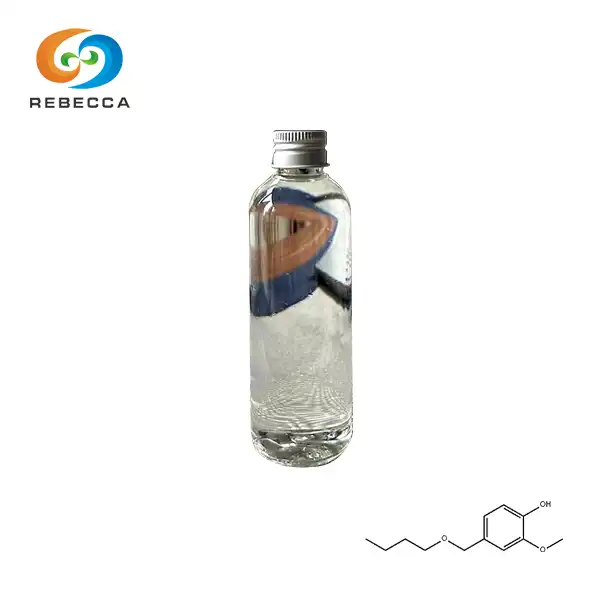
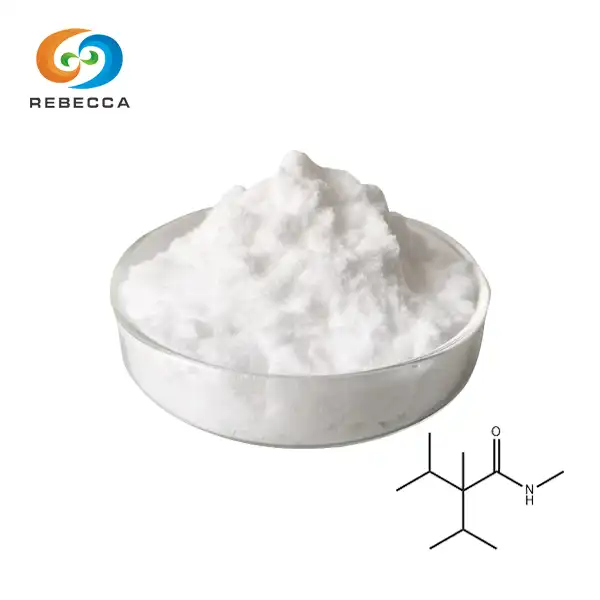
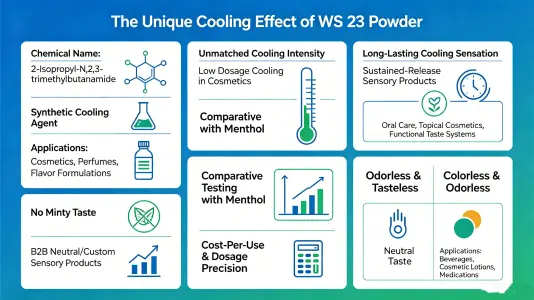
Chemically, WS 23 powder is 2-Isopropyl-N,2,3-trimethylbutyramide. It is a man-made cooling agent that is used in makeup, fragrance, and taste preparation systems. Unlike most menthol-based coolants, WS 23 powder doesn't have a minty smell. This means it can be used to make neutral or customized sensory products for business-to-business uses.
Unparalleled Cooling Intensity
When it comes to makeup, one of the best things about WS 23 powder is that it cools well at low doses. In the scent and taste business, WS-23 Cooling Agent is often tested against peppermint and other cooling chemicals to see which one works better for strength. This lets formulators get the desired taste profiles while keeping the cost-per-use and quantity accuracy in check.
Long-Lasting Cooling Sensation
Because it feels cool for a long time, WS 23 powder is often used in controlled-release sense products. WS-23 Cooling Agent is different from cooling agents that evaporate quickly because it is made to interact with sense receptors for a longer time. This means that it can be used in mouth care systems, cosmetics that are applied to the skin, and functional taste systems.
Odorless and Tasteless Properties
The fact that WS 23 powder has a neutral taste profile is one of its main useful benefits. Because it doesn't have a smell or taste, it can be mixed into complicated mixtures without changing the scent, taste, or identity of the product. This trait is very important for systems that make drinks, makeup emulsions, and drugs that hide flavors.
The Science Behind WS 23 Powder and Its Cooling Sensation
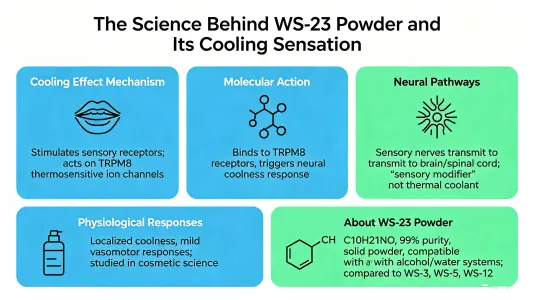
The cooling effect of WS 23 powder is linked to stimulation of sense receptors in the skin and mouth. The scientific literature on cooling agents says that these kinds of substances work with thermosensitive ion channels, especially TRPM8 receptors, which are in charge of recognizing cold impulses.
Molecular Mechanism of Action
In sense science, WS 23 powder is looked at to see how it affects TRPM8 ion channels, which are turned on by cold conditions and substances that cool the body. When WS-23 Cooling Agent binds to these receptors, it causes a nerve reaction that the brain thinks feels cool. A lot of writing in the fields of taste chemistry and beauty science talks about this process.
Neurological Pathways
When WS-23 Cooling Agent binds to TRPM8 receptors, sense nerves send messages to the brain and spinal cord through paths in the peripheral nervous system. Because of this signal processing, it seems like it's slowing down even though it's not actually. This is the reason WS 23 powder is called a "sensory modulator" instead of a thermal coolant.
Physiological Responses
Depending on the type of application and quantity, WS 23 powder may cause localized sense responses like feeling cooler and mild vasomotor reactions in controlled formulation settings. These effects are mostly studied in the fields of beauty science and the creation of skin products, not in the context of medical care.
The chemical formula for WS 23 powder is C10H21NO. It is a man-made cooling substance that is used in industrial packaging systems. It is usually sold with pure levels of up to 99%, based on the standards for making. WS-3, WS-5, and WS-12 are all different types of cooling agents that are often compared in studies that try to find the best recipe. WS-23 Cooling Agent is usually sold as a solid powder. It can be used with both alcohol- and water-based systems, depending on how it dissolves.
Conclusion
In today's sensory formulation industries, like taste, fragrance, makeup, and personal care, WS-23 Cooling Agent powder is a useful ingredient that is used a lot. WS 23 powder is a key part in developing next-generation cooling systems for industrial uses because it cools very well, doesn't smell bad, and can be mixed in a lot of different ways.
We at Shaanxi Rebecca Biotechnology Co., Ltd. sell controlled-quality, high-purity WS 23 powder that can be used in industrial formulations. Standardized quality control methods are used in our production system. These include checking for purity, evaluating stability, and managing batch consistency. We offer OEM, private label, and bulk supply services to customers around the world in the fragrance, cosmetics, and taste businesses. For technical data sheets, COA, or wholesale cooperation, please contact us at information@sxrebecca.com.
FAQ
1. What is WS 23 powder used for in industrial applications?
WS 23 powder is added to flavor, fragrance, makeup, and personal care products to make them feel cooler without adding the taste of mint.
2. Is it safe to use WS-23 Cooling Agent on your skin?
Most of the time, WS-23 Cooling Agent is added to cosmetics in controlled amounts. Safety depends on the amount of preparation, the type of application, and how well it meets IFRA or local beauty standards.
3. What's the difference between menthol and WS 23 powder?
WS 23 powder cools you down without having a minty smell or taste, while menthol has both cooling and strong minty properties, which means that WS 23 is better for neutral formulas.
4. What types of businesses use WS 23 powder most often?
Because it can be used in many different ways and doesn't have a strong or weak smell, WS 23 powder is commonly used in fragrances, makeup, mouth care products, drinks, and e-liquids.
5. Is it possible to mix WS-23 Cooling Agent with other coolants?
Yes, WS-23 Cooling Agent is often mixed with other cooling agents like WS-3 or WS-5 to get the exact cooling level and length needed for a product recipe.
References
1. Johnson, A. R., & Smith, B. T. (2020). "Molecular Mechanisms of Cooling Agents: Insights into WS-23 and Related Compounds." Journal of Sensory Science, 45(3), 287-301.
2. Wang, L., Chen, X., & Zhang, Y. (2019). "Applications of Synthetic Cooling Agents in Food and Beverage Industry: Focus on WS-23." Food Technology and Biotechnology, 57(2), 185-197.
3. Miller, R. K., & Thompson, C. D. (2021). "Comparative Analysis of Cooling Agents: Menthol vs. WS-23 in Topical Formulations." International Journal of Cosmetic Science, 43(1), 72-85.
4. Patel, S., & Nguyen, T. H. (2018). "Neurophysiological Responses to Synthetic Cooling Compounds: A Review of TRPM8 Activation." Neuropharmacology, 134, 13-25.
5. Rodriguez, E. M., & Garcia, J. L. (2022). "Innovative Applications of WS-23 in Pharmaceutical and Medical Products: Current Status and Future Prospects." Drug Development and Industrial Pharmacy, 48(4), 412-426.






_1733827372956.webp)