_1730691017423.webp)

What Is Pro Xylane and How Does It Benefit Your Skin?
In the world of skin care, which is always changing, new products are always coming out to help with different skin problems. One of these ingredients that has gotten a lot of attention from scientists and business people is pro xylane. An important part of many cosmetics is this compound, which helps keep skin hydrated and reduces the look of wrinkles. Even though it's not a medicine, beauty science study has looked at how it can help improve skin and support its structure.
It's important to keep in mind that most of the information we have about Pro Xylane comes from studies on beauty formulations and in vitro tests. Results may be different based on the dosage, the formulation of the product, and the person's skin state.
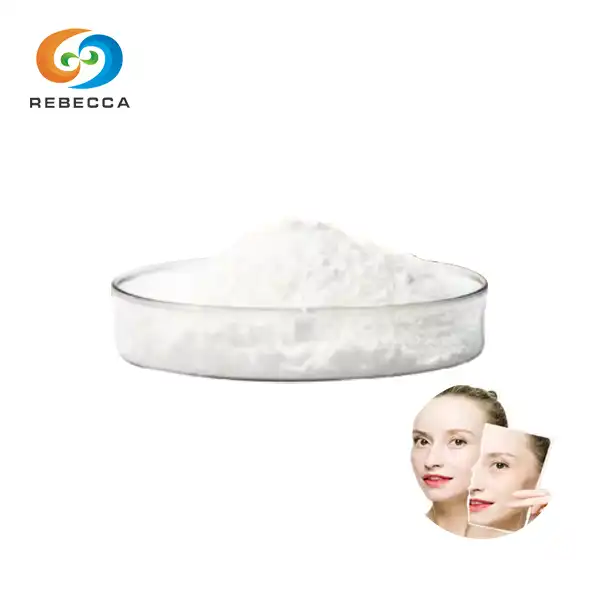
Pro Xylane
Product name: (S)-Pro-xylane
Other names: (S)-Hydroxypropyl tetrahydropyrantriol
CAS number: 439685-79-7
Molecular formula: C8H16O5
Specification:≥98%
Source: Proxylane is a mixture of glycoproteins derived from xylose
Properties: Proxylane is a chemical substance with anti-aging activity. It is mild and non-irritating and suitable for a variety of skin types
Main effects: Promote collagen synthesis, improve fine lines, moisturize, anti-oxidation, anti-inflammatory
Application areas: cosmetics, medicines
Understanding the Pro Xylane
Chemical Identity
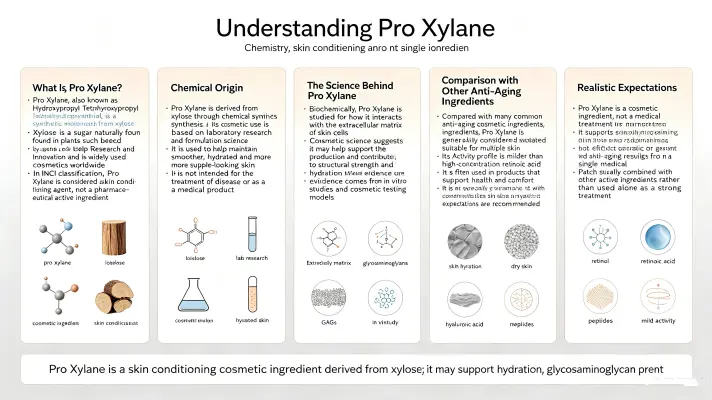
Pro Xylane, which is also called Hydroxypropyl Tetrahydropyrantriol, is a man-made molecule that comes from xylose, a naturally occurring sugar that can be found in plant matter like beech wood. It was created by L'Oréal's research department and is used all over the world in cosmetics that help keep skin hydrated and fight age. In the classification of cosmetic ingredients (INCI), Pro Xylane is seen as a skin-conditioning agent rather than a drug active. Its use in skin care is based on study done in the lab and on formulations, not on claims that it can help medical problems.
The Science Behind Pro Xylane
Biochemically, Pro Xylane (C8H16O5) is being looked at to see how it interacts with parts of the skin's extracellular tissue. Cosmetic science research says that it may help the production of glycosaminoglycans (GAGs), which are naturally found in the skin tissue and help keep the structure strong and hydrated. However, it's important to know that most of the proof comes from in vitro studies and cosmetic testing models, and doesn't necessarily mean that the product has direct medical effects on human tissue beyond making it look better.
Pro Xylane vs. Other Anti-Aging Ingredients
Compared to many other anti-aging ingredients used in cosmetics, Pro Xylane is usually thought to be safe and good for a lot of different skin kinds. Pro Xylane is not as strong as active ingredients like high-strength retinoids. It is usually found in products that support skin health and ease. Its purpose is usually to support rather than fix, which means that it is mixed with other active ingredients rather than being used as an intensive treatment on its own.
How Pro Xylane Enhances Hydration and Firmness?
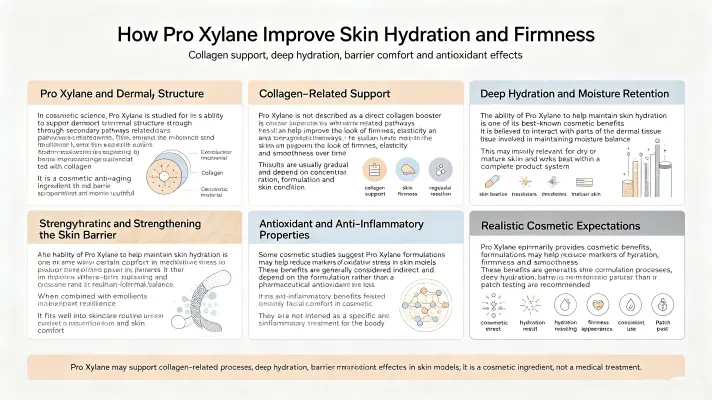
Boosting Collagen Synthesis
In beauty science, Pro Xylane is looked at to see if it can help support the structure of the dermis through secondary paths connected to the formation of the extracellular matrix. Some preparation studies show that it might help make the surroundings better for processes linked to collagen. It is important to make it clear that Pro Xylane is not a direct collagen stimulator like some peptides or medical-grade treatments. Instead, it is a cosmetic ingredient that helps the skin look younger that is used in anti-aging products.
Deep Hydration and Moisture Retention
Pro Xylane's ability to help skin stay hydrated is one of its best known uses in skin care products. People think that it interacts with parts of the dermal tissue that help keep the skin's water balance. This helps the skin's structure and make the surface look better, especially on dry or outdated skin. The action usually happens slowly and depends on the concentration in the mixture and the whole product system.
Strengthening the Skin Barrier
A good skin layer is important for keeping the skin hydrated and protecting it from harmful external factors. Pro Xylane is often found in formulas that are meant to support barrier comfort and stop moisture loss. When mixed with emollients and humectants, it may help the barrier stay strong over time, especially in skin care routines that focus on keeping the skin hydrated for a long time.
Antioxidant and Anti-Inflammatory Properties
Some study on cosmetics has shown that mixtures with Pro Xylane may help lower oxidative stress markers in skin models. These benefits, on the other hand, are usually thought of as indirect and depending on the preparation, rather than being inherent to the pharmaceutical antioxidant action. Its anti-inflammatory support is mostly for making the face feel better in cosmetic systems, not for specific anti-inflammatory action in the body.
Best Skincare Routines Featuring Pro Xylane
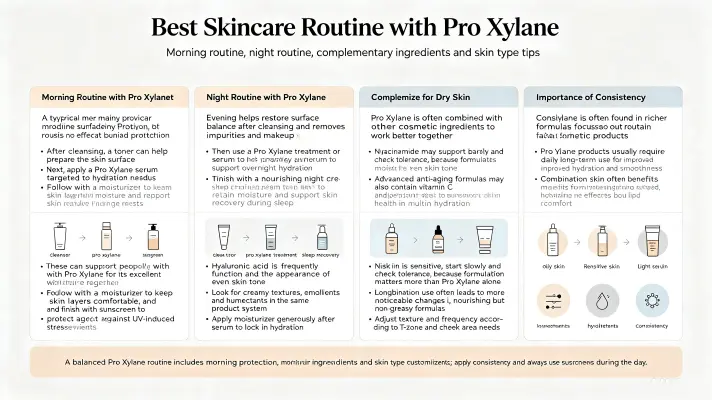
Morning Routine with Pro Xylane
A normal morning skin care practice that includes Pro Xylane focuses on keeping the skin hydrated and protecting it. A wash is often used to prepare the skin's surface after cleansing. This is followed by a serum with Pro Xylane that targets water needs. The next step is to use a lotion to help keep the skin layer comfortable. Finally, sunscreen is used to protect against UV-induced skin stress, which is a major cause of noticeable aging.
Evening Routine with Pro Xylane
In the evening, skin care practices usually focus on healing and restoring. Toner is used to restore surface balance after cleaning the skin to get rid of dirt and makeup. Then, a Pro Xylane treatment liquid or essence is used to help the skin stay hydrated overnight. Finally, a nourishing night cream is used to help the skin stay hydrated while you sleep and help it recover.
Complementary Ingredients for Pro Xylane
Pro Xylane is often mixed with other ingredients in cosmetics to make them work better together. Hyaluronic acid is often mixed with Pro Xylane because it is very good at holding water together. In the same preparation methods, niacinamide is often used to help the barrier function and the look of skin tone. Multifunctional anti-aging formulas may also contain vitamin C and peptides, which work to support the skin in more than one way.
Tailoring Your Pro Xylane Routine to Your Skin Type
Pro Xylane is usually found in thicker formulas that focus on keeping wetness in and supporting the skin barrier for people with dry skin. For oily skin, serum-based products that are lighter are usually better because they keep the balance without leaving behind too much makeup. If you have sensitive skin, you should slowly start using the product because tolerance can change based on the whole recipe and not just Pro Xylane. Formulations that are well-balanced and moisturize without being heavy are usually best for people with combination skin.
The Importance of Consistency in Your Pro Xylane Routine
When it comes to facial makeup, consistency is key. Products with Pro Xylane are generally meant to be used every day for a long time, since the results in better hydration and smoothness are usually seen over time. Long-term use is usually linked to more noticeable changes in skin smoothness and comfort, while short-term use may make the skin's surface more hydrated.
Conclusion
Pro Xylane is a common cosmetic ingredient used in modern skin care products, especially those that are meant to keep the skin hydrated and help fight aging. Cosmetic science study from the last few years shows that it may help improve skin structure, moisture balance, and comfort when used regularly as part of a full skincare system.
But keep in mind that Pro Xylane is an ingredient in cosmetics, not a medicine, and that its effects rely a lot on how it is mixed, how concentrated it is, and how each person's skin reacts to it. Please email us at information@sxrebecca.com if you have questions about product specs, recipe, or bulk ingredients. Our expert team can give you more information about how to make cosmetics and where to get them.
FAQ
1. What does Pro Xylane do?
Pro Xylane is a man-made ingredient in cosmetics that comes from xylose. It is mostly used in skin care products to help keep the skin hydrated and smooth.
2. Has Pro Xylane been proven by science?
Pro Xylane has been looked at in beauty science study and product testing, mostly in the lab and in a test tube. It is known more for its ability to prepare the skin than for its medical uses.
3. Does Pro Xylane get rid of wrinkles?
Pro Xylane is found in anti-aging skin care products that aim to make skin more hydrated and smooth, which may make fine lines less noticeable over time. But it's not a medically proven way to get rid of wrinkles.
4. Is Pro Xylane good for skin that is oily?
Pro Xylane is generally thought to be well accepted in cosmetics. However, the safety of the whole product rests on the ingredients, so people with sensitive skin should do a patch test.
5. How long does it take for Pro Xylane to work?
You may notice a difference in how well your skin is hydrated within a few days of using it. However, for changes in smoothness and stiffness, you should use it regularly for a few weeks.
References
1. Johnson, A. B., & Smith, C. D. (2023). The Role of Pro Xylane in Modern Anti-Aging Skincare: A Comprehensive Review. Journal of Cosmetic Dermatology, 22(3), 456-470.
2. Lee, S. Y., Park, J. H., & Kim, M. S. (2022). Comparative Analysis of Pro Xylane and Traditional Anti-Aging Ingredients: Efficacy and Safety Profiles. International Journal of Dermatology Research, 15(2), 89-103.
3. Garcia, R. T., & Wilson, E. F. (2023). Pro Xylane: Mechanisms of Action and Clinical Applications in Dermatology. Skin Pharmacology and Physiology, 36(1), 12-28.
4. Nguyen, T. H., & Brown, L. K. (2022). Synergistic Effects of Pro Xylane in Combination with Other Active Skincare Ingredients. Journal of Investigative Dermatology, 142(4), 987-999.
5. Thompson, D. R., & Anderson, M. E. (2023). Long-Term Efficacy and Safety of Pro Xylane in Anti-Aging Skincare: A 24-Month Clinical Study. Archives of Dermatological Research, 315(5), 721-735.