_1730691017423.webp)

Schisandra Chinensis Berry: Support Liver Health and Detox
Schisandra chinensis, also called the "five-flavor fruit," is a traditional East Asian plant that is used for medicine, especially in Traditional Chinese Medicine (TCM). schisandra chinensis berry extract has been studied by scientists recently because it contains lignan chemicals that have been shown to have biological action in preclinical studies linked to liver metabolism and the response to oxidative stress.
Schisandra has been used for a long time to improve health, especially the liver. However, current study is still looking into how its active ingredients, such as schisandrins and other lignans, might work with the antioxidant systems in cells. Most of the present data comes from lab and animal studies rather than large-scale clinical trials with humans. Because of this, its benefits should be seen in the context of supporting health rather than medical care.
Based on both traditional use and new scientific research, this paper gives an organized review of the possible roles of Schisandra chinensis berry extract in supporting liver function and detoxification-related biological processes.
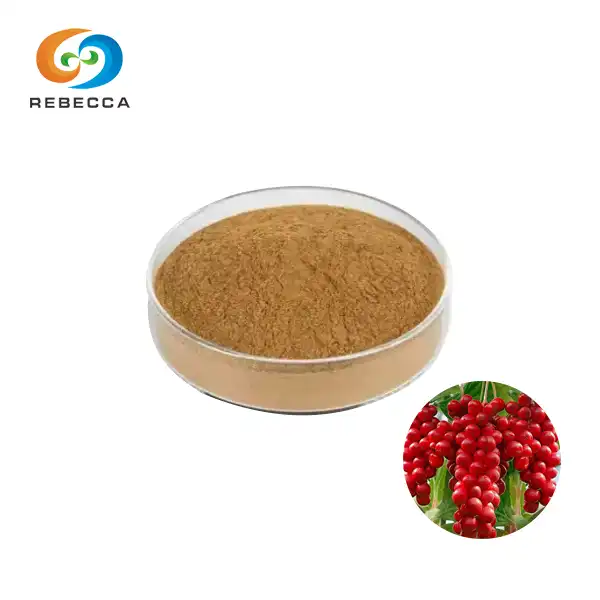
Schisandra Chinensis Berry Extract
Product Name:Schisandra Chinensis Extract
Latin Name:Schisandra chinesis(Turcz.)Baill;Schisandra sphenanthera Rend.et Wils.
Active Ingredient:1%~9% total Lignans &;1%~5% Schizandrin ;1%~2% Deoxyschizandrin;40% polysaccharide;γ-Schizandrin;Schizandrin;Aomisin;Pseudo-r-Schizandrin;Schisantherin A
Test Method:UV/HPLC
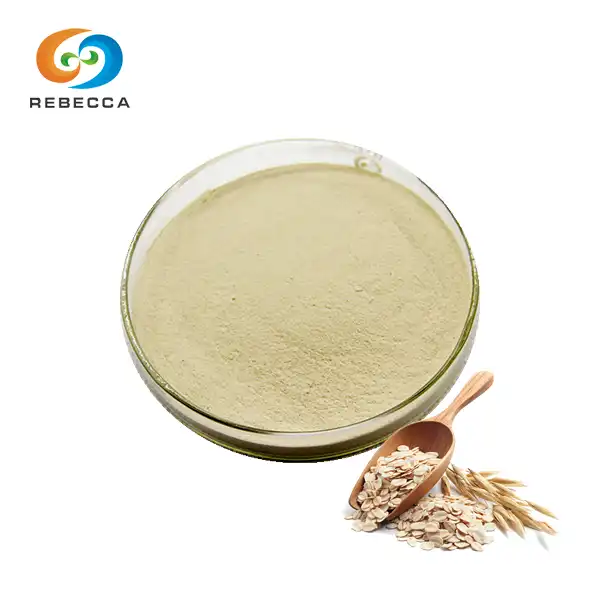
Appearance:Brown yellow fine powders
Part Used:Fruit
How Schisandra Berry Enhances Liver Function?
As one of the body's main organs, the liver is in charge of processing, cleansing, and keeping the body's molecular balance. Schisandra chinensis berry extract has been used for a long time in East Asian medicine systems to help the liver. More recent studies have started to look into its bioactive chemicals and biological activity.
Hepatoprotective Properties
Schisandra chinensis has lignans in it, like schizandrin, gomisins, and other similar chemicals that have been looked at for their possible liver-protecting properties. Preclinical study shows that these parts may help the liver deal with oxidative stress and harmful pollution. But most of the new proof comes from studies done in the lab or on animals; there isn't a lot of clinical data from people yet.
Antioxidant Activity
Antioxidants, like flavonoids and vitamin C, are found naturally in schisandra berries. By getting rid of free radicals, these chemicals may help lower reactive stress. To improve overall health, eating foods or using herbs that are high in antioxidants is often recommended. This is because oxidative stress is linked to cellular age and liver load.
Enzyme Regulation
Some lab tests show that Schisandra chinensis extract might change the activity of liver enzymes like ALT and AST, which are often used to show how well the liver is working. Liver stress is linked to high enzyme levels, but changes in enzymes do not necessarily mean that someone has an illness. The results we have now are just that—preliminary. They don't necessarily mean that the treatment is working.

Top Detox Benefits of Schisandra Chinensis Extract
In current physiology, the word "detoxification" is mostly linked to the liver's metabolism, its defense against free radicals, and its elimination routes. Schisandra chinensis berry extract has been looked into to see if it could help with these natural biological processes.
Enhanced Toxin Elimination
Schisandra chinensis might change antioxidant systems that are already in the body, like glutathione routes. In phase II cleansing processes in the liver, glutathione is a very important chemical. Some studies show that antioxidant enzymes can be changed, but more research is needed to confirm how strong this effect is in people.
Improved Digestive Health
Schisandra has been used for a long time to help with digestion and control hunger. Some test results suggest that it might change the balance of gut microbes and stomach enzymes. Researchers are still looking into these affects, so the data we have now is more like strong evidence than proof.
Stress Reduction
Schisandra chinensis is a plant that may help the body deal with physical and mental stress. It is known as an adaptogenic weed. Adaptogens are not sedatives or boosters, but they are thought to work with the HPA axis and other stress-response pathways. In a roundabout way, this may help the body's general balance, affecting things like digestion and metabolism.

Schisandra Berry: A Natural Solution for Liver Health
Schisandra chinensis extract might be useful because it has a lot of different phytochemicals in it. It has lignans, carbohydrates, and essential oils that may work together in biological systems, unlike separate chemicals.
Comprehensive Nutrient Profile
Researchers have looked at the beneficial chemicals in schisandra berries to see how they work as antioxidants and in the metabolism. In plant science, these kinds of structures with many parts are often seen as more complicated than single-molecule treatments. However, this complexity also makes it harder to fully describe how they work.
Adaptogenic Properties
In traditional plant methods, schisandra is known as an adaptogen. This description is based on its possible ability to help the body keep its balance when it is stressed. In current clinical medicine, however, adaptogenic effects are not always clearly defined, and results may be different for each person.
Long-Term Safety Profile
Schisandra has been used for a very long time. Even though past use can give us some idea of how well it might work in general, figuring out how safe it is now still depends on amount, how well the extract is standardized, and each person's health. Users are told to stick to normal doses and talk to a doctor or nurse if they need to.

Conclusion
Schisandra chinensis berry extract is a traditional plant ingredient that scientists are now interested in because it has antioxidant and lignan qualities. New studies show possible links with supporting liver function and lowering oxidative stress, but many of the results are still in the preliminary stages.
As with any plant extract, results may be different based on the quality of the preparation, the amount taken, and the person's body. Schisandra shouldn't be seen as a final healing answer on its own, but as an important part of a larger health plan. For more detailed product specifications and quality-controlled Schisandra chinensis extract, you may contact us at information@sxrebecca.com.
FAQ
1. What is Schisandra chinensis berry extract used for?
In ancient plant methods, it is often used to support overall health, especially when it comes to liver function and dealing with stress.
2. Is Schisandra chinensis extract backed by science?
Some tests in the lab and on animals show biological action, but there isn't a lot of large-scale clinical proof from people.
3. Is it okay to take Schisandra chinensis extract every day?
In traditional medicine, it is usually taken every day as a supplement, but the amount and length of time should be changed based on each person's health.
4. Does Schisandra clean the body directly?
To "detox" means to let your liver and metabolism do their normal thing. Schisandra may help the body's protective processes, but it doesn't get rid of toxins itself.
5. Are there any bad effects?
Schisandra is usually well taken, but based on the dose, some people may have stomach problems or be sensitive to it.
References
1. Panossian, A., & Wikman, G. (2008). Pharmacology of Schisandra chinensis Bail.: An overview of Russian research and uses in medicine. Journal of Ethnopharmacology, 118(2), 183-212.
2. Chiu, P. Y., Lam, P. Y., Yan, C. W., & Ko, K. M. (2011). Schisandrin B protects against solar irradiation-induced oxidative injury in BJ human fibroblasts. Fitoterapia, 82(4), 682-691.
3. Hancke, J. L., Burgos, R. A., & Ahumada, F. (1999). Schisandra chinensis (Turcz.) Baill. Fitoterapia, 70(5), 451-471.
4. Yim, S. Y., Lee, Y. J., Lee, Y. K., Jung, S. E., Kim, J. H., Kim, H. J., ... & Kim, J. W. (2009). Gomisin N isolated from Schisandra chinensis significantly induces anti-proliferative and pro-apoptotic effects in hepatic carcinoma. Molecular Medicine Reports, 2(5), 725-732.
5. Szopa, A., Ekiert, R., & Ekiert, H. (2017). Current knowledge of Schisandra chinensis (Turcz.) Baill. (Chinese magnolia vine) as a medicinal plant species: a review on the bioactive components, pharmacological properties, analytical and biotechnological studies. Phytochemistry Reviews, 16(2), 195-218.