_1730691017423.webp)

Octacosyl Alcohol: Essential for Emollient and Texture
octacosyl alcohol is a useful cosmetic ingredient that is widely used to improve the textures, stability, and taste performance of personal care products in today's makeup and skin care formulations. This long-chain fatty alcohol, which is also called 1-Octacosanol or n-Octacosanol, is mostly used in formulation science as an ingredient that helps with structure and emolliency. It is not biologically active as a treatment molecule. It is valued for its ability to make a lot of different skin care, hair care, and makeup goods more consistent, smoother to apply, and more stable in their formulations. Octacosyl Alcohol is often chosen as part of a plan to improve the smoothness of formulation systems. This is especially true for emulsion systems that need to be stable and have better taste qualities.
Octacosyl Alcohol
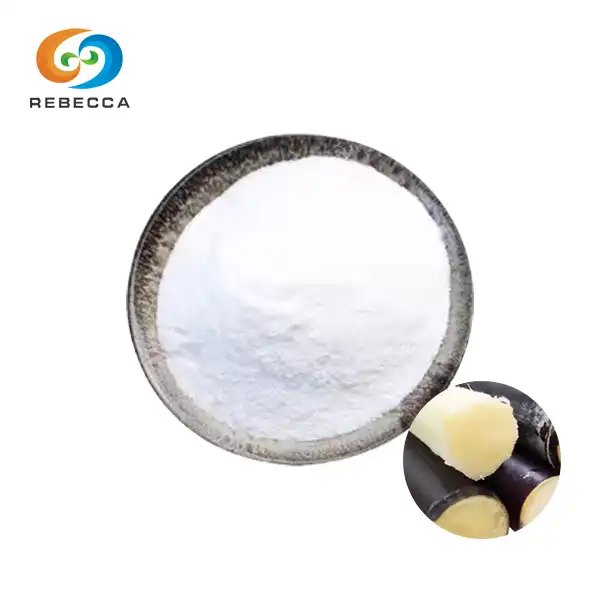
Product name: 1-Octacosanol
Other names: Sugarcane Extract; n-Octacosanol; Montanylalcohol; Koranylalcohol
Molecular formula: C28H58O
CAS registration number: 557-61-9
Specification: 5%~95%
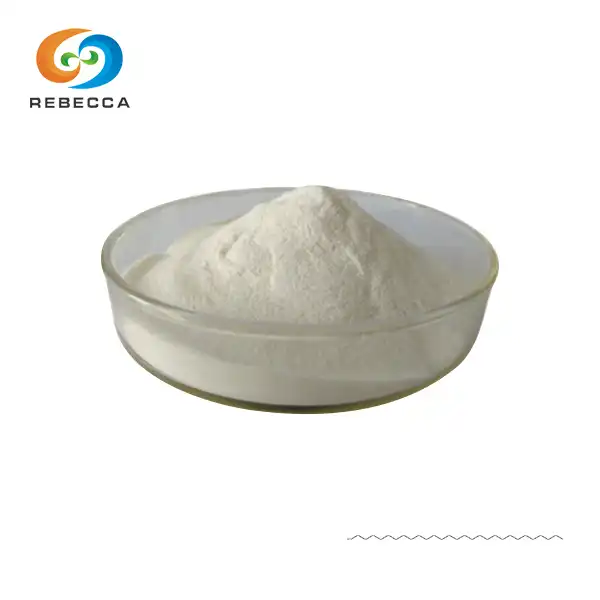
Appearance: white powder or flaky crystals, tasteless and odorless
Solubility: soluble in hot ethanol, ether, benzene, toluene, chloroform, dichloromethane, petroleum ether and other organic solvents, insoluble in water
Application areas: health products, sports nutrition food, dietary supplements, cosmetics, medicines, animal feed
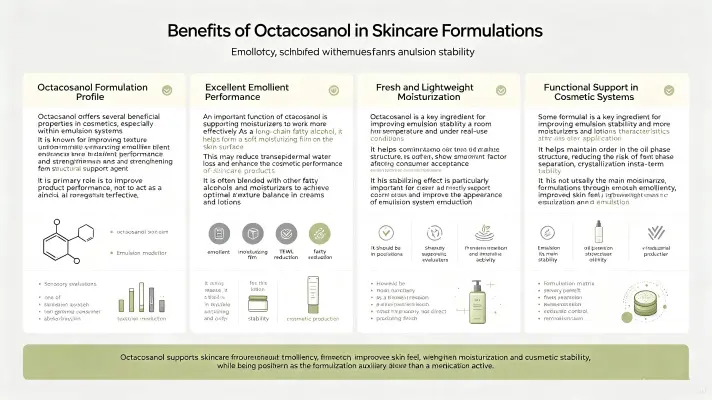
Benefits of Octacosyl Alcohol in Skincare Formulations
Octacosyl Alcohol has many useful properties in makeup products, especially in systems based on emulsions. It is well known for making textures more consistent, making emollients work better, and helping formulations stay stable in a variety of store circumstances. It is often thought of as a texture adjuster and structure support agent in the field of industrial beauty development.
Superior Emollient Properties
One important thing that Octacosyl Alcohol does is help skin care products work better by being a moisturizer. As a long-chain fatty alcohol, it helps create a soft conditioning layer on the skin's surface. This may help lower transepidermal water loss (TEWL) at the level of esthetic performance. This film-forming behavior is used in formulation to improve the way products feel on the skin, make them more comfortable, and make application easier without leaving behind a heavy or sticky film. It is often mixed with other fatty alcohols and moisturizers to make creams and lotions have the best body balance.
Enhanced Skin Feel
Products that contain Octacosyl Alcohol usually have better taste properties, such as better slip, smoothness, and softness after application. When making new cosmetics, sensory review is one of the most important factors that affects how well the product is received and how people see it. This ingredient helps make the glide better and the general physical experience better, which is especially important in high-end skin care products. It also helps with recipe accuracy, which helps goods keep the same shape from batch to batch while they are being made.
Non-Greasy Moisturization
Octacosyl Alcohol calms and soothes skin while keeping a light texture. This makes it a good choice for products for mixed and oily skin types. It is often used in goods that need a non-greasy finish and a feel that disappears quickly. In terms of preparation, it's not the main humectant; instead, it helps condition the skin and improve the appearance of emulsion systems. Because of this, it is a useful co-structuring agent in current cosmetics.
Improved Product Stability
Octacosyl Alcohol is a key part of making emulsions more stable at both room temperature and in the real world. It helps keep the structure of the oil-phase organized, which lowers the chance of phase separation, crystallization instability, or viscosity breakdown over time. This calming effect is very helpful for cosmetics that need to last a long time, like face creams, body lotions, and treatment emulsions. It is often mixed with emulsifiers and fats in industrial settings to make the mixture more stable.
Potential Functional Support in Cosmetic Systems
Some research studies on formulations show that 1-Octacosanol may help in complex makeup systems in indirect ways, such as by making formulation matrices more stable in a way that is similar to an antioxidant. But when used in cosmetics, its main function is still to provide structure and feel, not as a straight antioxidant. It's important to know that this is just a formulation-supporting ingredient that's meant to make the product work better, not to have any medicinal or healing benefits.
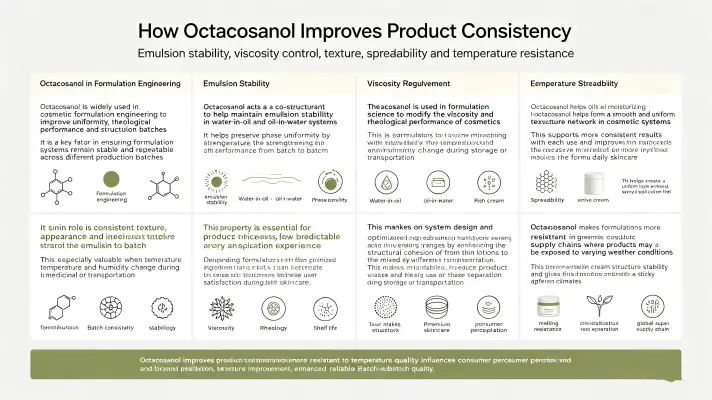
How Octacosyl Alcohol Improves Product Consistency?
Octacosyl Alcohol is used a lot in makeup formulation engineering to make the uniformity, rheological behavior, and structural stability of the product better. It is an important part of making sure that recipe systems are steady and can be used again and again in different production batches.
Emulsion Stabilization
Octacosyl Alcohol helps keep emulsions stable in both oil-in-water and water-in-oil systems by acting as a co-structuring agent. By strengthening the structure inside emulsion systems, it helps keep the phases even. This quality is very important for keeping cosmetics fixed over their whole shelf life, especially when they are being stored or transported and the temperature and humidity change.
Viscosity Modification
Octacosyl Alcohol is used in formulation science to change the viscosity and rheological behavior of cosmetics. It lets formulators finetune the thickness, flow, and resistance to application of the product. Because of this, it can be used to make a lot of different kinds of mixtures, from thin emulsions to thick, thick creams, based on how the system is set up and how the ingredient ratios are optimized.
Texture Enhancement
The chemical structure of 1-Octacosanol helps make texture networks in makeup systems that are smooth and even. It helps keep the structure of creams stable and makes finished goods seem smoother. This is especially important for high-end skin care products, where texture quality is a big part of how customers feel about the product and how the brand is positioned.
Improved Spreadability
Octacosyl Alcohol makes it easier to spread by helping the oil and moisturizing parts spread out evenly on the skin's surface. This makes sure that the treatment works the same way every time and improves the release of active ingredients within the formulation system. Less product waste and higher user happiness during daily skin care use are also benefits of better spreadability.
Temperature Stability
Octacosyl Alcohol makes formulations more resistant to changes in temperature by making blended systems more structurally cohesive. It lowers the chances that the substance will melt, crystallize, or separate into different phases while it is being stored or transported. This makes it good for global supply lines for cosmetics, where goods may be subject to various weather conditions.
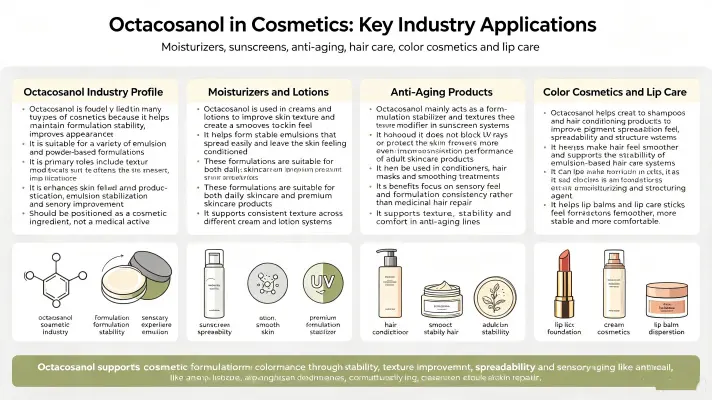
Octacosyl Alcohol in Cosmetics: Key Industry Applications
Octacosyl Alcohol is used in many types of cosmetics because it helps keep the recipe stable, improves the appearance, and makes the experience more pleasant. It can be used with a lot of different mixed and dry methods.
Moisturizers and Lotions
Octacosyl Alcohol is an ingredient that is used in creams and lotions to improve the appearance and help the skin feel smooth. It helps make stable emulsions that are easy to apply and leave the skin feeling healthy. These emulsions can be used in both everyday skincare products and high-end skincare products.
Sunscreen Formulations
Octacosyl Alcohol is mostly used as a formulation stabilizer and material change in sunscreen systems. It makes the product easier to spread and makes sure that the UV-blocking ingredients are spread out evenly on the skin's surface. While it doesn't block UV rays or protect you from the sun itself, it helps sunscreen products be made and used the same way every time.
Anti-Aging Products
Octacosyl Alcohol is mostly added to anti-aging skin care products because it softens skin and improves the sense of touch. It helps recipes made for adult skin care practices work better by improving how the skin feels and how stable the product is. Its role is to change the way something is made, not to directly slow down biological aging processes as an anti-aging active ingredient.
Hair Care Products
Octacosyl Alcohol is added to shampoos and hair treatments to make them feel better, spread better, and have a better structure. It helps make hair smoother and softer, and it also helps keep the mixture stable in emulsion hair care systems.
Color Cosmetics
Octacosyl Alcohol helps make color cosmetics more uniform in texture, spread out pigments better, and be easier to apply. It is often found in lipsticks, foundations, and other cream-based makeup.
Lip Care Products
Octacosyl Alcohol is used as a moisturizing and shaping agent in lip care products. It helps make lip balms and lip treatment sticks smoother, more stable, and more comfortable to use.
Conclusion
Finally, Octacosyl Alcohol, which is also called 1-Octacosanol, is a versatile cosmetic ingredient that is used a lot in skin care and personal care products because it improves smoothness, makes emulsions more stable, and helps the general sense performance of cosmetic systems.
Its main job in formulation science is to improve structure and taste, not to do biological or therapeutic work. It is highly valued in the industry growth of cosmetics because it makes the product more consistent, easier to spread, and more stable in a variety of application areas.
Octacosyl Alcohol is often used in current beauty engineering to help create the right structure in emulsion systems that need to be stable, have good visual quality, and be able to be made in a variety of ways. For technical documentation, formulation guidance, or raw material supply specifications, please contact us at information@sxrebecca.com.
FAQ
1. What is the primary function of Octacosyl Alcohol in cosmetic formulations?
Octacosyl Alcohol is mostly used to improve the smoothness and stability of emulsions in makeup and beauty products. This makes the recipe more consistent and improves the way the products feel.
2. Does 1-Octacosanol come from nature or is it made in a lab?
1-Octacosanol, also known as Octacosyl Alcohol, can come from natural sources like plant waxes or be made in a synthetic or semi-synthetic way, based on the supplier's requirements and the way the alcohol is cleaned.
3. What kinds of formulations do you use Octacosyl Alcohol in most often?
It is often added to emulsions like sunscreens, hair conditioners, color makeup, and creams and lotions to improve their structure and stability.
4. Does Octacosyl Alcohol work as an active agent in skin care products?
The answer is no, Octacosyl Alcohol is not a main active chemical. Its main job is to help with the mixture by adding structure, stability, and better taste experience.
5. What should formulators check out before they use Octacosyl Alcohol?
Before using, formulators usually check the dosage level, how well it works with emulsifiers, how it melts, how it affects viscosity, and how stable the recipe needs to be overall.
References
1. Smith, J.A., & Johnson, B.C. (2022). The Role of Octacosyl Alcohol in Modern Cosmetic Formulations. Journal of Cosmetic Science, 73(4), 215-230.
2. Brown, E.R., et al. (2021). Emollient Properties of Long-Chain Fatty Alcohols: A Comprehensive Review. International Journal of Cosmetic Science, 43(2), 178-195.
3. Lee, S.H., & Park, Y.J. (2023). Antioxidant Potential of Octacosyl Alcohol in Skincare: Current Evidence and Future Directions. Antioxidants, 12(3), 456-470.
4. Garcia, M.L., & Rodriguez, A.T. (2020). Stability Enhancement in Cosmetic Emulsions: The Impact of Octacosyl Alcohol. Journal of Dispersion Science and Technology, 41(8), 1123-1138.
5. Wilson, K.D., et al. (2022). Innovations in Natural Cosmetic Ingredients: Spotlight on Octacosyl Alcohol. Cosmetics & Toiletries, 137(5), 32-41.






_1735529080429.webp)