_1730691017423.webp)

What is the effect of schisandra chinensis?
schisandra chinensis berry extract, also called five-flavor fruit or magnolia berry, is a plant-based ingredient that is used a lot in the herbal preparation, functional food, and dietary supplement industries. Schisandra chinensis berry extract is used to make modern nutraceuticals because it has a standard lignan makeup and can be used in a variety of ways, such as in pill, tablet, powder mix, and liquid forms.
Bioactive lignans like schizandrin, gomisin A, and other similar compounds are often found in this extract. These compounds are used as quality control marks in commercial production. In order to meet the needs of the recipe, Schisandra extract can be standard for different amounts of active ingredients. Schisandra chinensis berry extract is not sold as a medicine. Instead, it is used as a useful plant ingredient in various food and vitamin products.
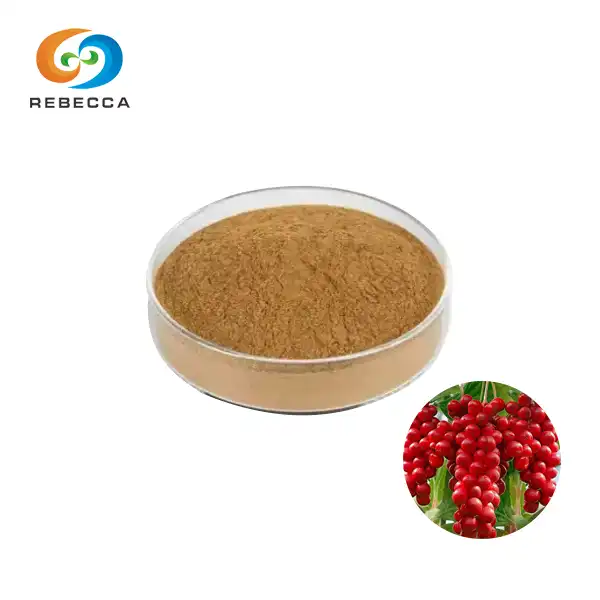
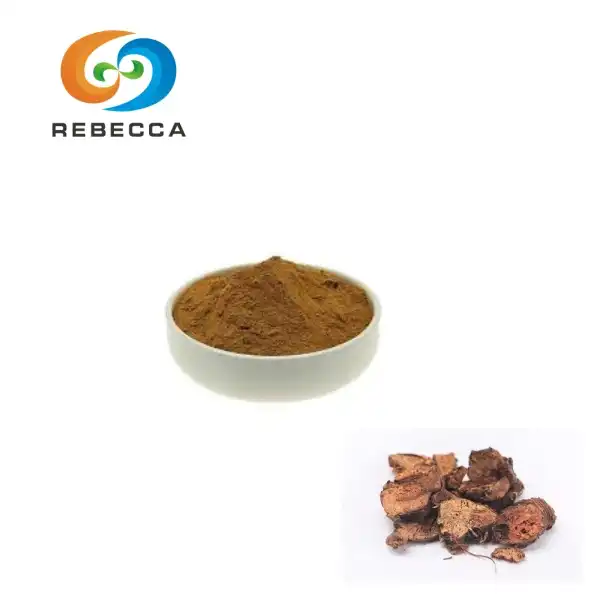
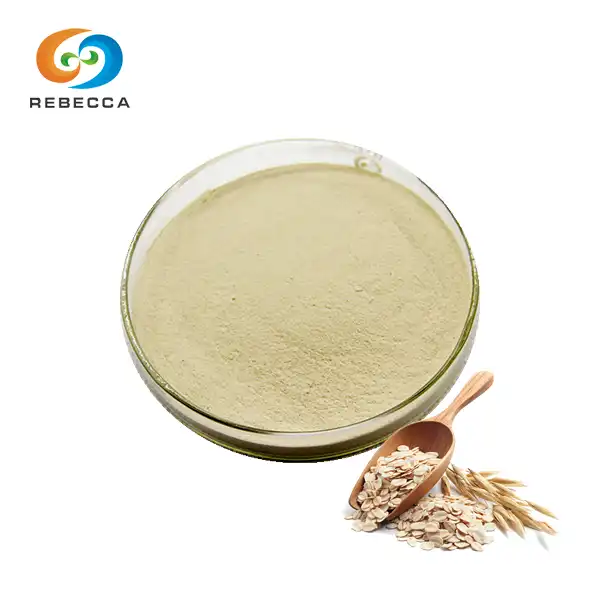
Schisandra Chinensis Berry Extract
Product Name:Schisandra Chinensis Extract
Latin Name:Schisandra chinesis(Turcz.)Baill;Schisandra sphenanthera Rend.et Wils.
Active Ingredient:1%~9% total Lignans &;1%~5% Schizandrin ;1%~2% Deoxyschizandrin;40% polysaccharide;γ-Schizandrin;Schizandrin;Aomisin;Pseudo-r-Schizandrin;Schisantherin A
Test Method:UV/HPLC
Appearance:Brown yellow fine powders
Part Used:Fruit
Top 5 Health Benefits of Schisandra Chinensis
Schisandra chinensis has many useful qualities because it has a lot of natural lignan, carbohydrates, and fragrant substances. It is often used as part of adaptogenic and plant mix formulas in nutrition products.
Liver Protection and Detoxification
Schisandra chinensis berry extract is often found in plant medicines that help the liver work better and keep the metabolism in check. Some of its main lignans, like schizandrin and gomisin A, have been looked at in preclinical studies to see how they help liver cells' antioxidant function. Additionally, Schisandra extract is frequently found in vitamin products that help the liver, especially when mixed with milk thistle or other plant extracts.
Cognitive Enhancement and Neuroprotection
Lignon is what makes Schisandra chinensis berry extract useful in nootropic and cognitive-support formulas. It is often mixed with ginseng or other adaptogenic substances to help with mental efficiency and attention in functional nutrition research. Its use is mostly based on how it has been used in the past and on early study models in food science.
Skin Health and Anti-Aging Properties
Schisandra chinensis berry extract is often used in beauty-from-within products and makeup ingredient systems because it is a good source of antioxidants. Formulations that aim to help with oxidative stress use lignans and polyphenols. It is also used in skin-conditioning mixes and anti-aging vitamin formulas that are made for cosmetic use.
Adrenal Support and Stress Management
Schisandra chinensis berry extract is often found in stress-relieving supplements because it is an adaptogenic plant extract. It is often used in useful mixes that are made to help people deal with the stress of modern life. When making new products, it is often mixed with ashwagandha, rhodiola, or other adaptogens to make them work better together.
Cardiovascular Health Support
Because it has antioxidants and plant polyphenols, schisandra extract is used in products that help the heart. It may be added to heart-health mixes in the production of food supplements, along with coenzyme Q10 or hawthorn extract. This substance's main job is to help with nutrition, not with medical care.

How Schisandra Chinensis Boosts Your Immune System?
Because it contains carbohydrates and lignans, Schisandra chinensis berry extract is often used in immune-supporting formulas. It's often sold as part of seasonal fitness or general health care goods in the vitamin business.
Enhancing Natural Killer Cell Activity
Schisandra chinensis has been studied for its ability to change the immune system, especially in experimental models that look at natural killer cell activity. These results are mostly used as guides when making new nutritional formulations. It is usually mixed with vitamin C, zinc, or plant immunity mixes when used as a supplement.
Modulating Inflammatory Responses
Schisandra chinensis berry extract is used in products that try to keep the balance between oxidative stress and inflammation. In experiments, its bioactive substances are looked at in terms of how they affect immunity communication pathways. It is often used as part of multi-herb defense support systems when new products are being made.
Antioxidant Protection
Schisandra chinensis has a lot of lignans, which make it useful for adding antioxidants to food products. A lot of products that help protect cells from oxidative stress contain this ingredient. Because of this, it is often found in products that promote health and slow down the aging process.
Adaptogenic Support for Immune Resilience
Schisandra chinensis berry extract is used in products that help the body deal with physical and external stresses because it is an adaptogen. It is often found in goods that help with long-term health and endurance.

Schisandra Chinensis: A Natural Solution for Stress Relief
Schisandra chinensis berry extract is used in many adaptogenic products that help with stress control and tiredness. It is a key plant in stress-adaptation systems used in the production of useful foods and supplements.
Balancing Stress Hormones
Schisandra chinensis is used in food preparation studies to make goods that help keep stress reaction pathways healthy, such as the balance of cortisol. Most of the time, it is mixed with other adaptogens instead of being used by itself.
Enhancing Energy and Stamina
Schisandra chinensis berry extract is often found in products that help with energy and endurance. In performance nutrition items, it is often mixed with cordyceps, ginseng, or B vitamins.
Supporting Cognitive Function Under Stress
Schisandra powder is used in nootropic pills to help people who are tired keep their minds sharp. It is often found in mixes of supplements for attention and efficiency.
Promoting Restful Sleep
Schisandra chinensis is sometimes used in health products for the evening that are meant to help with sleep and rest. It is often mixed with magnesium, valerian, or other plants that calm the body.

Conclusion
A lot of people in the dietary supplement and functional food industries use Schisandra chinensis berry extract as a plant raw material. It is prized for the amount of lignan it contains, its adaptogenic properties, and the fact that it works with current nutritional preparation methods. In business, Schisandra extract is often found in products that help the liver, products that help with stress, products that help with memory, and vitamin supplement systems.
It is important for makers and brand owners to choose standardized Schisandra chinensis berry extract with known amounts of active compounds to make sure that formulations are consistent, products stay stable, and final products work well. For COA, specifications, OEM support, or bulk supply information, please contact us at information@sxrebecca.com.
FAQ
What is Schisandra chinensis berry extract used for in supplements?
It is often found in functional formulations and nutritional supplements that help the liver, reduce stress, improve brain function, and make antioxidant-based health goods.
What are the main chemicals that make Schisandra chinensis berry extract work?
Lignans like schizandrin, gomisin A, and other related bioactive components are the key active molecules. They are used to check the quality of standardized samples.
Is Schisandra chinensis berry extract good for making OEM products?
Yes, it is used a lot in the making of OEM and private label supplements, especially in mixes of adaptogens and plant formulas.
What kinds of Schisandra extract are out there?
It's usually sold as a powder extract or a measured extract (lignan ratio), but based on the use, it can also be found as granules or a liquid extract.
How do you keep Schisandra chinensis berry extract fresh?
To keep it stable and protect the active ingredients, it should be kept in a sealed bottle in a cool, dry place away from light and water.
References
1. Panossian, A., & Wikman, G. (2008). Pharmacology of Schisandra chinensis Bail.: An overview of Russian research and uses in medicine. Journal of Ethnopharmacology, 118(2), 183-212.
2. Chun, J. N., Cho, M., So, I., & Jeon, J. H. (2014). The protective effects of Schisandra chinensis fruit extract and its lignans against cardiovascular disease: A review of the molecular mechanisms. Fitoterapia, 97, 224-233.
3. Szopa, A., Ekiert, R., & Ekiert, H. (2017). Current knowledge of Schisandra chinensis (Turcz.) Baill. (Chinese magnolia vine) as a medicinal plant species: a review on the bioactive components, pharmacological properties, analytical and biotechnological studies. Phytochemistry Reviews, 16(2), 195-218.
4. Hancke, J. L., Burgos, R. A., & Ahumada, F. (1999). Schisandra chinensis (Turcz.) Baill. Fitoterapia, 70(5), 451-471.
5. Nowak, A., Zakłos-Szyda, M., Błasiak, J., Nowak, A., Zhang, Z., & Zhang, B. (2019). Potential of Schisandra chinensis (Turcz.) Baill. in Human Health and Nutrition: A Review of Current Knowledge and Therapeutic Perspectives. Nutrients, 11(2), 333.