_1730691017423.webp)

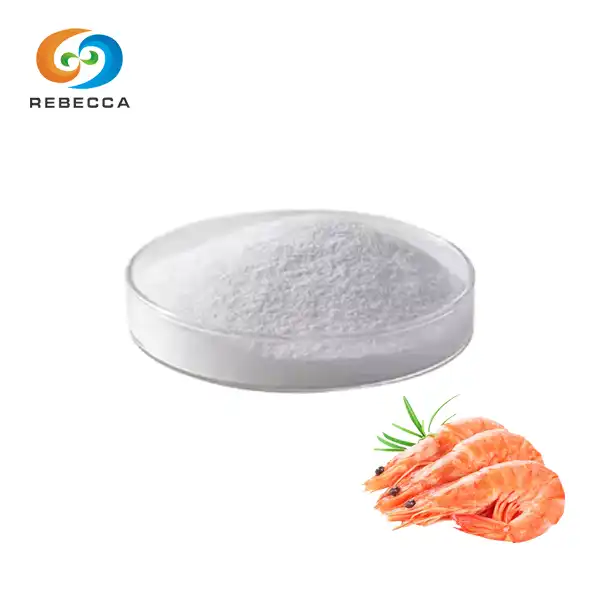

Water Soluble Chitosan Powder in Food Industry Uses
The food business has adopted water-soluble chitosan powder as an all-purpose ingredient, taking advantage of its many useful qualities. This natural polymer, whose chemical name is polyglucosamine (1-4)-2-amino-B-D glucose, helps make food better and keep it fresh for longer.
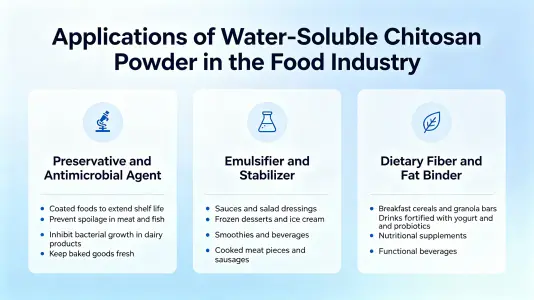
Preservative and Antimicrobial Agent
As a natural addition and antibacterial agent, water-soluble chitosan powder is one of the most important things used in the food business. Chitosan has an interesting atomic structure that lets it attach to microbial cell layers and stop the growth of yeasts, molds, and other microorganisms. Because of this, it is a great alternative to manufactured chemicals, meeting the growing demand from customers for clean-label products.
Water-soluble chitosan powder can be added to a variety of foods, including:
• Foods that are coated to keep them fresh longer
• Meat and fish to keep them from going bad
• Foods made from milk to stop germs from growing
• Baked items to keep them fresh
Emulsifier and Stabilizer
Chitosan powder, which is water-soluble, has excellent stabilization and emulsifying qualities, making it a crucial ingredient in food details. Because it can create stable emulsions and keep stages from separating, it helps improve the surface, stability, and quality of many food products. Here are some applications:
• Sauces and salad dips
• Frozen treats and ice cream
• Smoothies and drinks
• Meats and sausages cut up and cooked
Dietary Fiber and Fat Binder
As a food fiber, water-soluble chitosan powder has many health benefits, such as helping the body absorb nutrients better and possibly lowering weight. Because it can bind to dietary fats in the gut, it is used in healthy foods and vitamins that aim to lower cholesterol and help people lose weight.
Some foods that have water-soluble chitosan powder added to them as a form of fiber are:
• Cereals and granola bars for breakfast
• Drinks with yogurt and probiotics
• Supplements for nutrition
• Drinks with functions
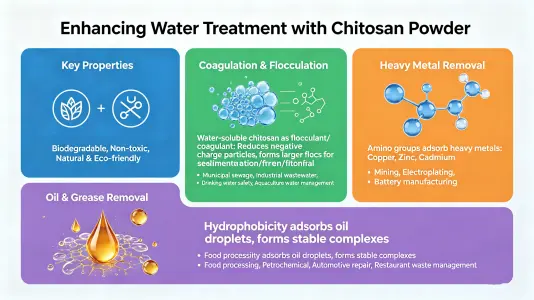
Enhancing Water Treatment with Chitosan Powder
Chitosan powder is an essential resource in water treatment forms due to its unusual qualities. Because it can get rid of contaminants and is biodegradable and non-toxic, it is a naturally friendly alternative to common poisons used to clean water.
Coagulation and Flocculation
In water treatment systems, water soluble chitosan powder works well as a flocculant and coagulant. Because it is cationic, it can reduce negatively charged particles in water. This helps bigger flocs form that are easy to remove by sedimentation or filter. There are times when this process comes in handy:
• Wastewater treatment systems for cities
• Treatment of industrial waste water
• Making drinking water safe
• Managing water for aquaculture
When used in these ways, chitosan can make the water clearer, less cloudy, and better at getting rid of organic matter and dissolved solids.
Heavy Metal Removal
Water-soluble chitosan powder can bind heavy metals, which is one of its most surprising qualities. The groups of amino acids that make up chitosan's nuclear structure can form bonds with metal particles that remove them from water. Because of this, chitosan is a great choice for cleaning water that has been contaminated with
• Take charge
• Copper
• Zinc
• Cadmium
• The sun
Chitosan-based water treatment systems can help industries like mining, electroplating, and battery making follow strict environmental rules and leave less of an impact on the environment.
Oil and Grease Removal
The ability of water-soluble chitosan powder to remove oil and oil from trash is excellent. Because it is hydrophobic, it can stick to oil beads and form stable complexes that are easy to separate from water. This house is especially important in
• Businesses that process food
• Shell oil plants
• Service shops for cars
• Treatment of restaurant garbage
These businesses can meet environmental standards and have less of an effect on marine environments by using chitosan-based treatments to lower the amount of oil and grease in their waste water.
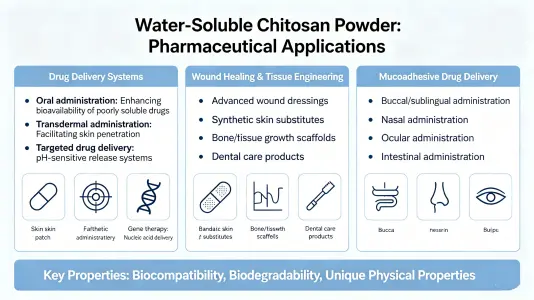
Water Soluble Chitosan Powder for Pharmaceutical Uses
Pharmaceutical companies have realized that water-soluble chitosan powder has huge promise in drug delivery systems and other medical uses. Because it is biocompatible, biodegradable, and has unique physical qualities, it is a very appealing cloth for making creative medicinal items.
Drug Delivery Systems
Water-soluble chitosan powder is an important part of the success made in advanced drug delivery systems. Because it can form nanoparticles and microparticles, it can contain and release other helpful specialists in a controlled way. Here are some important applications:
• Oral drug delivery: making drugs that don't dissolve well more bioavailable
• Transdermal drug delivery: making it easier for drugs to get through the skin and be absorbed
• Targeted drug delivery: creating release systems that are sensitive to pH and specific to the spot
• Gene therapy: making it easier for nucleic acids to get to the right cells
Because chitosan can be used in a lot of different ways to deliver drugs, it is used in a lot of different medicinal forms, such as pills, capsules, creams, and nanoparticle solutions.
Wound Healing and Tissue Engineering
The biocompatibility and antibacterial qualities of water-soluble chitosan powder make it a great choice for tissue engineering structures and wound healing. Because it helps cells stick together, grow, and change into new types, it is used in
• Advanced bandages for wounds
• Skin substitutes made of plastic
• Supports for bone and tissue growth
• Things for teeth
In these situations, chitosan-based products can help wounds heal faster, lower the risk of infection, and help damaged tissues grow back.
Mucoadhesive Drug Delivery
People have used the ability of water-soluble chitosan powder to stick to mucosal surfaces to make new slow moving systems that work on these surfaces. This feature allows for longer touch time between the drug and the absorption area, which could lead to more useful ampleness. These are some examples of uses in this area:
• Drug delivery by buccal and sublingual
• Putting drugs in the nose
• Getting drugs into the eyes
• Drug delivery through the intestines
Using chitosan-based mucoadhesive systems, drug firms can make better medicines for a wide range of conditions, which will help patients follow their treatments better and improve therapy results.
Conclusion
Microcrystalline chitosan powder that dissolves in water has become useful and useful in many fields. Its use in the medicine field, the water treatment industry, and the food industry show how powerfully it can solve problems and lead to new ideas. The need for high-quality chitosan powder is likely to increase a lot as more study is done to find new uses and improve current ones.
If you want to find out more about chitosan powder price or are looking for a trusted provider, Shaanxi Rebecca Biotechnology Co., Ltd. is the leader in making natural plant products. We offer a wide range of chitosan goods designed to meet the needs of different industries because we care about quality, innovation, and customer happiness. Please email us at information@sxrebecca.com to find out more about our services or to talk about your unique needs.
References
1. Kumar, M. N. V. R. (2000). A review of chitin and chitosan applications. Reactive and Functional Polymers, 46(1), 1-27.
2. Rinaudo, M. (2006). Chitin and chitosan: Properties and applications. Progress in Polymer Science, 31(7), 603-632.
3. Dutta, P. K., Dutta, J., & Tripathi, V. S. (2004). Chitin and chitosan: Chemistry, properties and applications. Journal of Scientific and Industrial Research, 63(1), 20-31.
4. Younes, I., & Rinaudo, M. (2015). Chitin and chitosan preparation from marine sources. Structure, properties and applications. Marine Drugs, 13(3), 1133-1174.
5. Crini, G., & Badot, P. M. (2008). Application of chitosan, a natural aminopolysaccharide, for dye removal from aqueous solutions by adsorption processes using batch studies: A review of recent literature. Progress in Polymer Science, 33(4), 399-447.